
Use Case - Data Movement & Migration
Move billions of files
and prove it
Any-to-any migration and replication across POSIX, NFS, SMB, and object, on-premises and cloud, using parallel multi-platform agents. Discovery comes from the catalog rather than a file-system walk, and every action is stateful and tracked.
Built for refreshes, cloud adoption, consolidations, and M&A integrations that cannot be allowed to overrun.
Plan
Know what you are moving before you move it
Discovery comes from the Unstructured Data Catalog rather than a file-system walk, and the catalog is used to consolidate and clean the data beforehand so there is less to move.
Discovery from the catalog
The inventory already exists. Planning starts from a current picture instead of a scan you have to schedule.
Shrink the job first
Consolidate and clean the data before the move, so the migration carries less and finishes sooner.
Preview without moving a byte
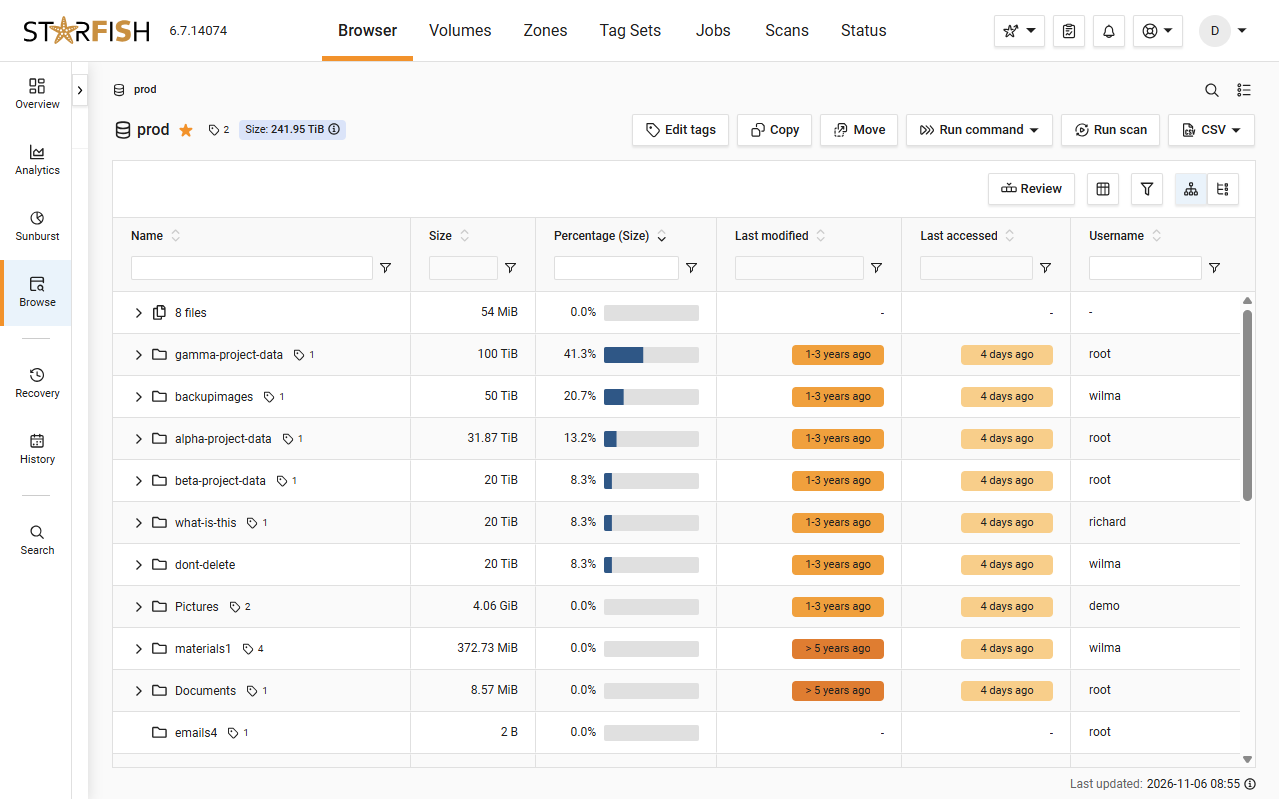
Simulate a transfer and verify the resulting inventory before committing - used to de-risk a forklift upgrade in advance.
Parallel multi-platform agents
Linux and Windows agents deploy in multiples and run parallel threads, which is what makes billion-file moves finite.
Starfish Automation Engine
Rehearse the migration on your own data
No synthetic demo. Preview simulates the transfer against your environment and verifies the resulting inventory before anything moves.
Move
Any-to-any, on-premises and cloud
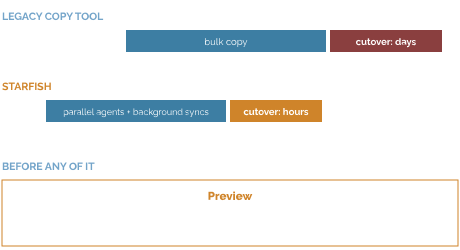
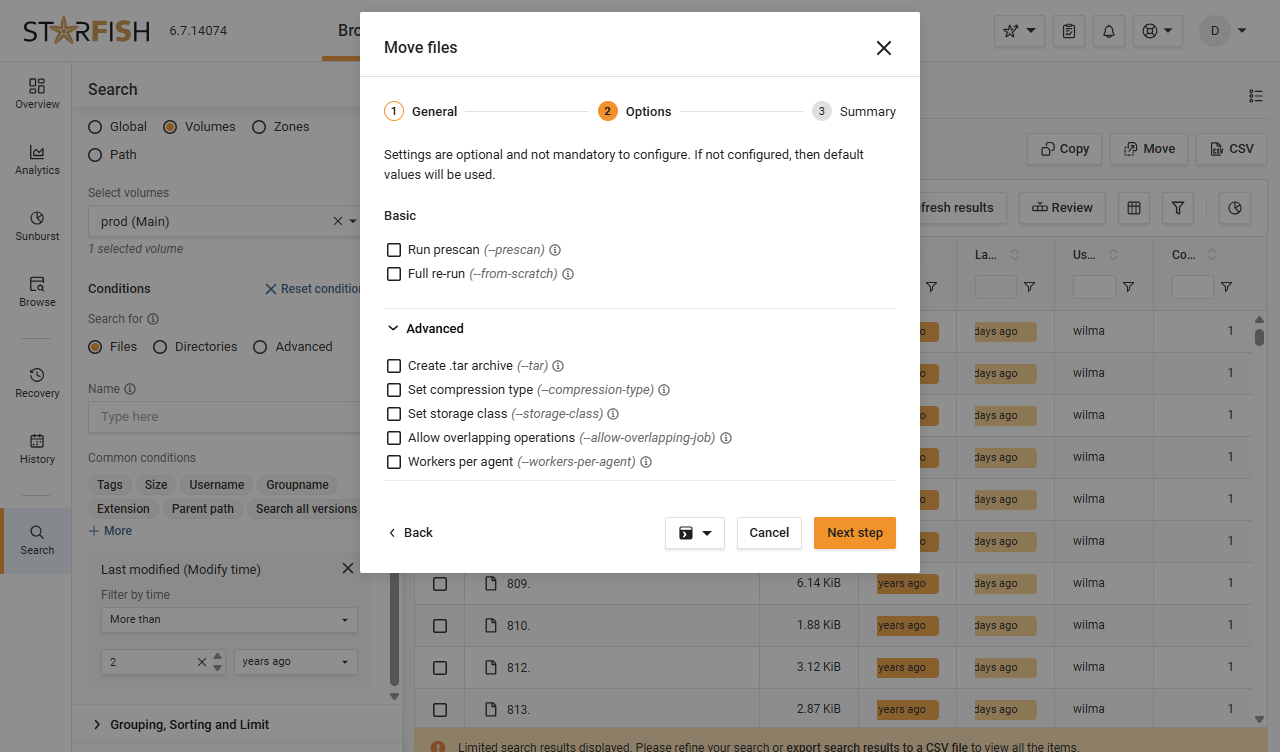
The Starfish Automation Engine moves and replicates across POSIX, NFS, SMB, and object storage, preserving permissions and running incremental background syncs so the cutover is short.
Any-to-any
POSIX, NFS, SMB, and object, on-premises and in cloud - the same engine, the same job definition.
ACLs preserved
Permissions are preserved across POSIX, SMB, and NFS, which is where most migrations get stuck.
Cutover in hours, not weeks
Incremental background syncs run continuously, so the final cutover is a short delta rather than the whole file estate.
Stateful and resumable
Job records mark moved files, so a run interrupted by a network outage resumes without re-transferring what already arrived.
Prove
Chain of custody, not a hope
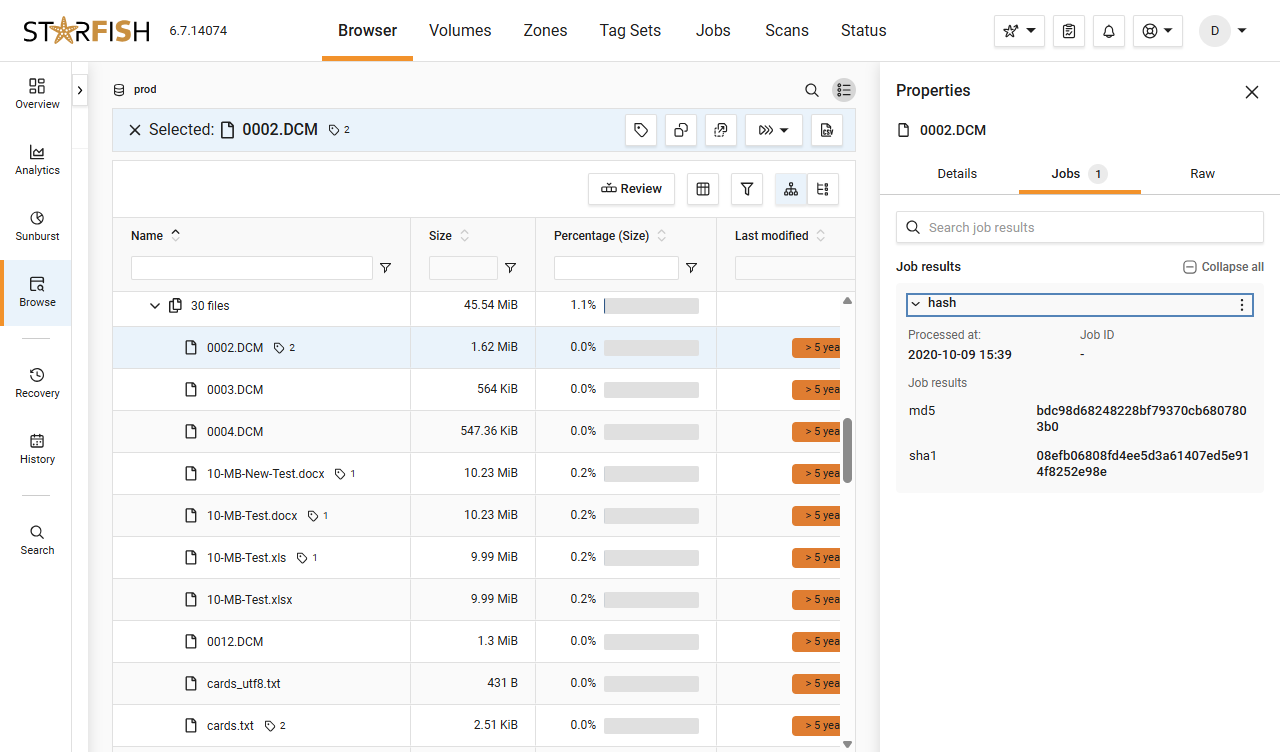
Integrity is monitored throughout, with pre- and post-verification, hash verification, and file tree diffs, producing documentation that satisfies auditors rather than an assurance that it probably worked.
Pre- and post-verification
The inventory is checked before and after, so “did everything arrive” has an answer rather than an opinion.
Hash verification
Content is verified cryptographically, not inferred from file counts and sizes.
File tree diffs
Differences between source and destination are reported rather than discovered later by a user.
Audit-ready documentation
Chain-of-custody records that satisfy auditors and compliance requirements come out of the job, not a side project.
In Practice
“With Starfish, I was able to do a complete lift and shift of ~2.5 PB of data from one storage system to a new one in less than two weeks.”
Senior Storage Engineer
A nonprofit biomedical research institute
Dig Deeper
Resources for the curious technical reader

Blog
How ASU scratch storage went from instability to control
ASU used Starfish to help researchers stop using scratch storage for permanent archive and bring storage utilization down to 70%
4-min read

Blog
How Starfish Storage delivers daily wins in data management to the University of Utah’s Scientific Computing and Imaging Institute
The University of Utah’s Scientific Computing and Imaging Institute uses Starfish Storage every day to manage a massive research data set, resolve hidden data issues and migrate data without interrupting researchers.
4-min video
Glossary
Get everyone using the same words
Storage admins, data owners, and finance can all say “cold data” and mean three different things. The glossary pins each term to one plain definition.
Quick reference
FAQ
Frequently asked questions
Which platforms can Starfish migrate between?
Any to any: POSIX, NFS, SMB, and object, on-premises and cloud. Starfish is qualified across enterprise NAS and HPC file systems and fourteen qualified object stores.
How do you avoid a months-long discovery phase?
Discovery comes from the catalog rather than a file-system walk, so the inventory is already there - and the catalog is used to consolidate and clean the data first, which shrinks the workload.
What happens to permissions?
ACLs are preserved across POSIX, SMB, and NFSv4.
How long is the cutover?
Incremental background syncs run continuously, so the cutover drops from weeks to hours - the final pass is a delta, not the estate.
How do we know everything arrived intact?
Pre- and post-verification, hash verification, and file tree diffs, producing chain-of-custody documentation that satisfies auditors and compliance requirements.
Can we test a migration before committing to it?
Yes. Preview simulates a transfer and verifies the resulting inventory without moving a byte - one customer used it to de-risk a forklift upgrade before moving anything.
Ready When You Are
Tell us about the migration you have been postponing.
We will preview it against your own data - not a synthetic demo - and show you what the real job looks like.