
Use Case - Data Protection
Backups that finish
inside the window
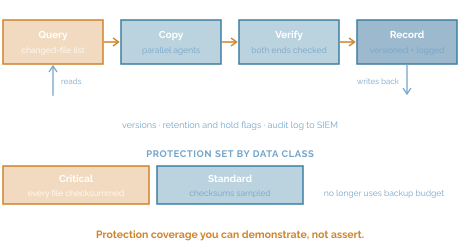
Rather than walking the tree, Starfish queries the catalog to generate a precise changed-file list, then distributes copying across multiple agents running parallel threads to S3, Azure, and POSIX targets. Backups are incremental, stateful, and versioned.
Built for environments where a tree walk can no longer complete inside a 24-hour window.
Scan
Stop walking the tree to find out what changed
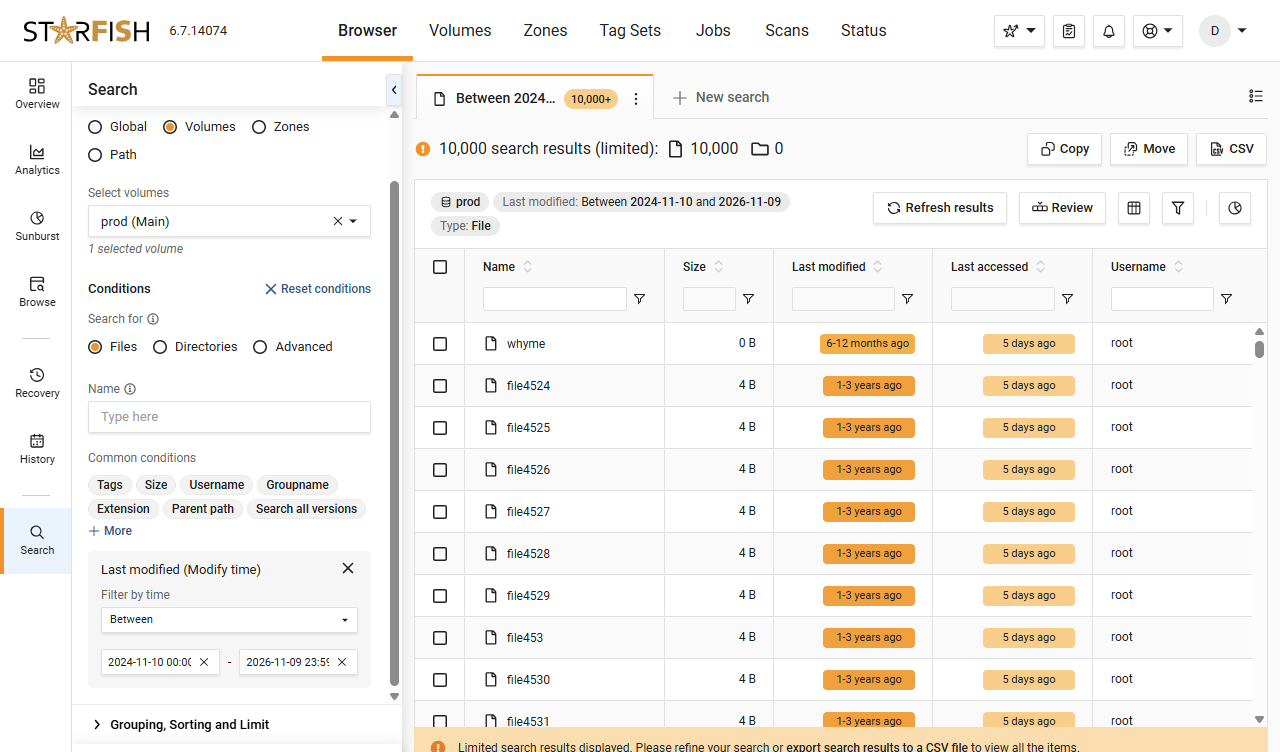
The changed-file list comes from the Unstructured Data Catalog, not from a traversal - which is the difference between a backup that completes and one that is still running when the next one starts.
A precise changed-file list
Generated by querying the catalog, so the backup starts with exactly what changed and nothing else.
Scan Accelerators
Native integrations for Lustre, GPFS, Isilon, Qumulo, HPSS, VAST, and WEKA detect only what changed.
Snapshot reads
Reads can come from storage snapshots rather than live file systems, so production is not interrupted and access times stay clean.
Parallel agents
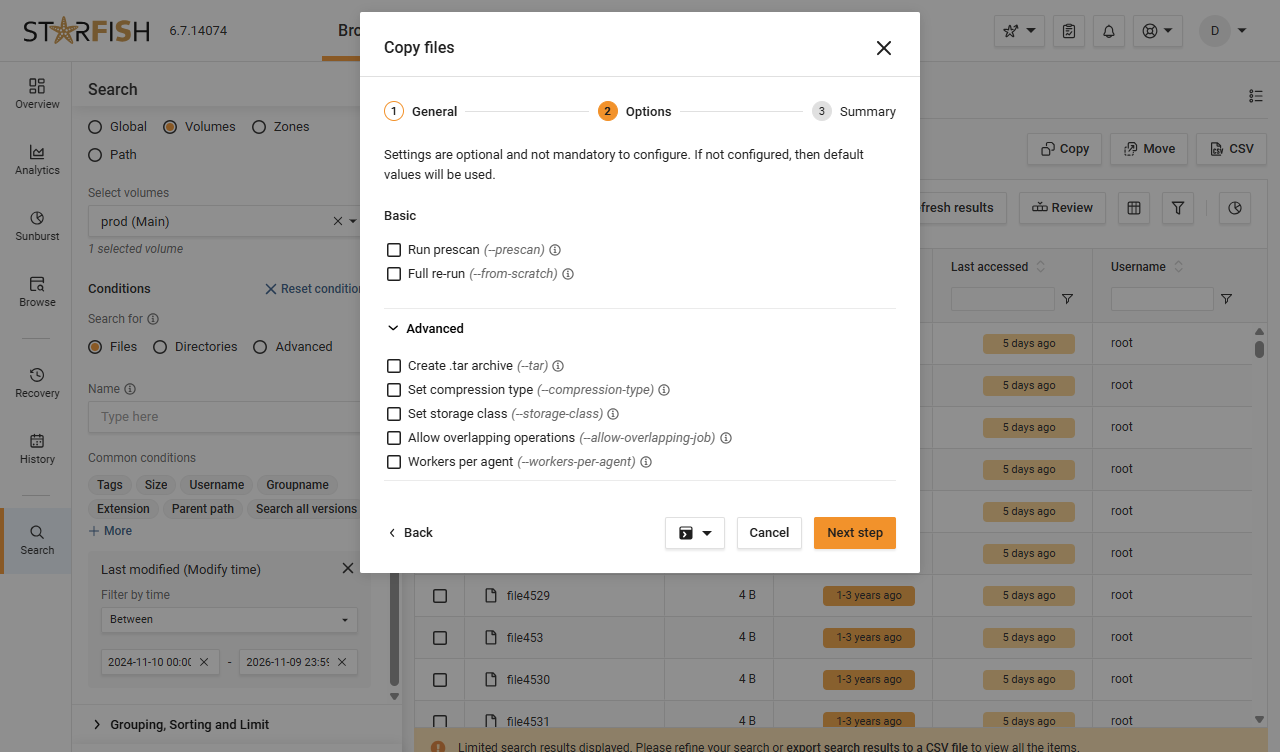
Copying is distributed across multiple agents running parallel threads, which is how the window holds as data grows.
Unstructured Data Catalog
Find out how long your change detection really takes
No synthetic demo. We run change detection against your own volumes and show you the number.
Protect
Protect deliberately, not just by default
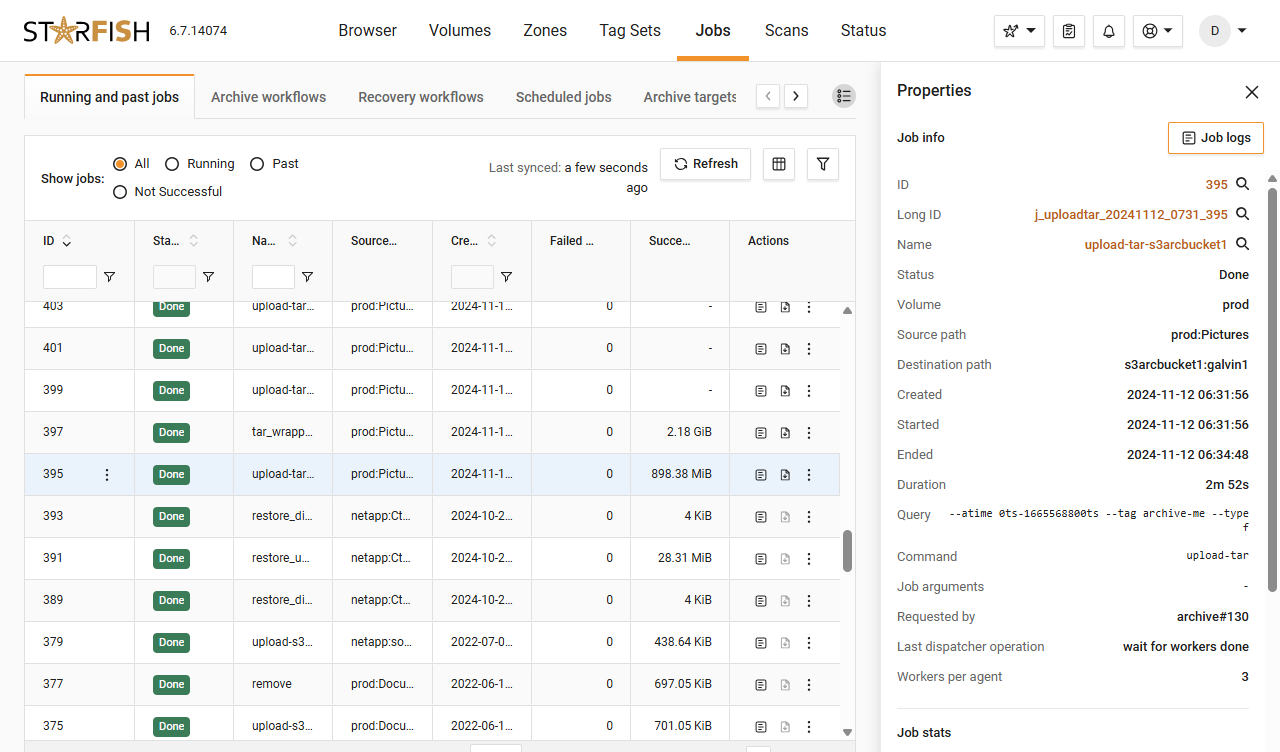
Backups run to S3, Azure, and POSIX targets, incrementally and statefully, with versioning - and restores are selective, so critical data comes back first rather than last.
Incremental and stateful
Versioned backups to S3, Azure, and POSIX targets, resuming where they left off rather than starting again.
Selective restores
Critical data comes back first, without restoring everything else to get to it.
Not everything, identically
Low-value data does not have to be protected like critical data, which takes cost out of the infrastructure.
Retention and holds
Retention dates and hold flags exclude held files from deletion, automatically.
Prove
Verified, not assumed
Starfish validates file metadata before and after every backup and compares cryptographic checksums across source and destination files, with protocol-level header matching enforced on cloud and object targets.
Metadata validated both ways
Checked before and after every job, so a successful job means the files are actually there.
Checksums compared
Cryptographic checksums are compared across source and destination, not inferred from counts.
Header matching on object
Protocol-level header matching is enforced for cloud and object targets.
Logged and exportable
Every action is logged to the catalog and exportable to SIEM, with role-based permission boundaries and audit reporting over the estate.
In Practice
“It used to take seven or eight hours just to scan our project space. Now, with the accelerator, we're talking about a scan that runs in a matter of seconds, leaving us much more time to do the actual backup.”

Becky Ligon, Storage Architect
Clemson University Research Infrastructure
Dig Deeper
Resources for the curious technical reader

Blog
Customer Spotlight: Starfish Storage makes data easier to find, store and protect for Clemson University’s Research Computing and Data Infrastructure team
Clemson Research Computing and Data Infrastructure team shares how they use Starfish to shrink the backup window from a week to less than 24 hours, easily find sensitive files, and empower researchers.
4-min read

Blog
How Starfish Storage delivers daily wins in data management to the University of Utah’s Scientific Computing and Imaging Institute
The University of Utah’s Scientific Computing and Imaging Institute uses Starfish Storage every day to manage a massive research data set, resolve hidden data issues and migrate data without interrupting researchers.
4-min video
Glossary
Get everyone using the same words
Storage admins, data owners, and finance can all say “cold data” and mean three different things. The glossary pins each term to one plain definition.
Quick reference
FAQ
Frequently asked questions
Why do traditional backups fail at this scale?
They rely on slow, metadata-heavy tree walks to work out what changed, and a tree walk cannot complete inside a backup window once an environment reaches billions of files.
Does Starfish replace our backup product?
Starfish is a backup engine for large datasets to S3, Azure, and POSIX targets. Which workloads it takes on depends on your environment - that is a conversation worth having with an expert.
How is a backup verified?
File metadata is validated before and after every backup, cryptographic checksums are compared across source and destination, and protocol-level header matching is enforced on cloud and object targets.
Can we restore selectively?
Yes. Backups are incremental and stateful with versioning, and restores are selective, so critical data comes back first without restoring everything. Restores can be delegated to file owners via Zones for self-service.
Does backup interrupt production?
Not necessarily. Starfish operates out of band, and can read from storage snapshots rather than live file systems, so access times are not updated.
Is the activity auditable?
Yes. Every action is logged to the catalog and exportable to SIEM systems, and audit reporting across the backup estate.
Ready When You Are
Tell us which volume no longer fits in the window.
We will run change detection on your own data.not a synthetic demo,and show you what the window could look like.