
Use Case - Data Classification
Know what's inside
your files
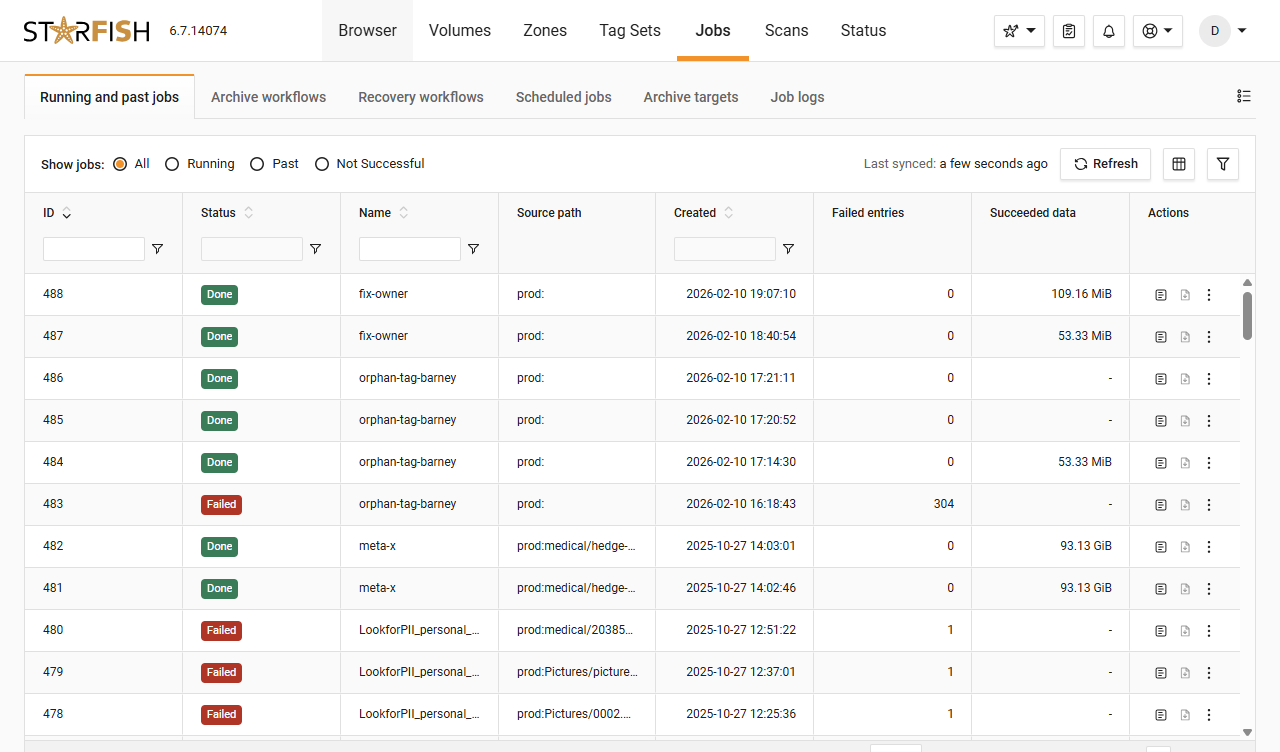
Meta-x opens file headers and extracts internal attributes from a wide and rapidly expanding catalog of formats, including DICOM, HDF5, and BAM, and stores the results as custom key-value metadata in the catalog - where the whole file estate is searchable in one query.
Built for billions of files, where governance has to be finer-grained than filenames and folder structure allow.
Exctraction
Read what is actually inside your files
The Meta-x metadata extractor opens file headers and extracts internal attributes, storing the results as custom key-value metadata in the Starfish Unstructured Data Catalog (UDC) rather than writing to the file itself.
A wide and expanding format catalog
Scientific and media formats including DICOM, HDF5, and BAM. Custom file types are supported on request.
Into the catalog, not the file
Extracted attributes are stored as custom key-value metadata in the UDC, so the source file is left as it is.
Append from anywhere
Catalog metadata can be appended by custom scripts, sidecar file ingestion, and third-party applications.
Out of band
Starfish never sits in the data path, and reads can come from storage snapshots rather than live file systems.
Unstructured Data Catalog
See classification working on your actual data
No made-up demos. We point Starfish at your environment and show you what is sitting inside your files.
Classification & Search
Tag once. Find anything.
Across billions of files.
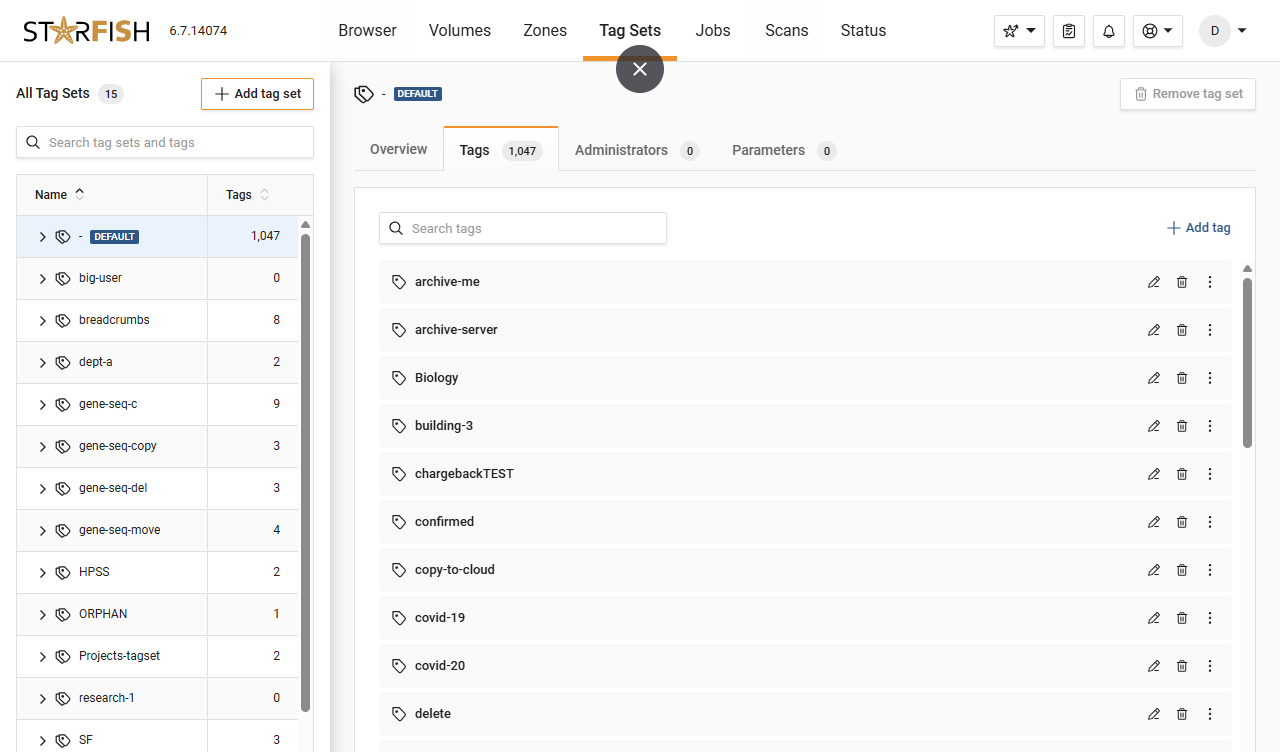
Tags and TagSets classify files and directories and are themselves searchable. One query spans inheritable directory metadata, filesystem attributes, Tags, and extracted metadata together.
Tags and TagSets
Classify files and directories to match how your organization actually governs files. Tags are searchable in their own right.
One query, four sources
Search inheritable directory metadata, filesystem attributes, Tags, and extracted metadata together, in a single query.
Assemble datasets
Find files and build a dataset from the result, rather than hunting a directory tree for what should be in it.
Curation by the people who know
Zones delegate curation to data owners, so the people who understand the data help classify it.
Governance & Automation
Turn classification into action
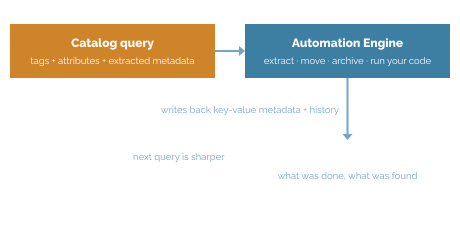
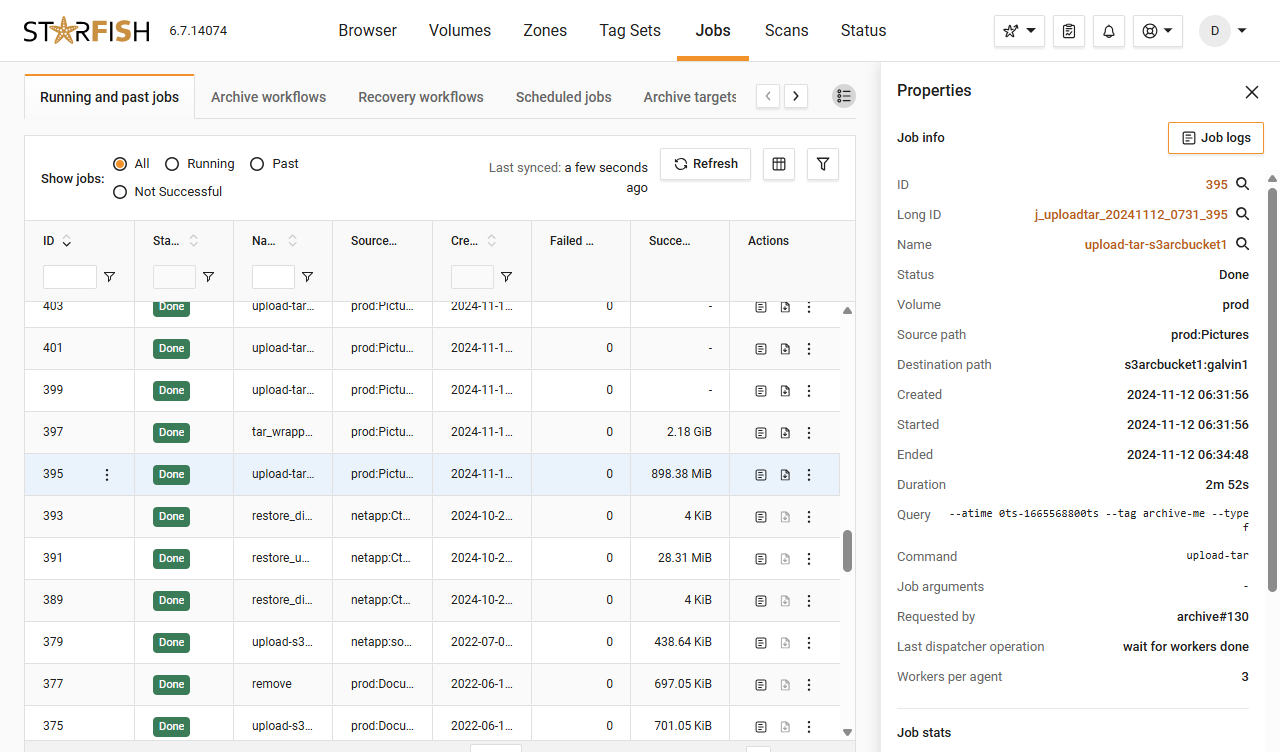
The Starfish Automation Engine enforces archive, movement, or deletion policy directly from classification - and writes the outcome back to the catalog, so the result of one job becomes the input to the next.
Policy from classification
Archive, movement, and deletion policy run against what classification found, without a separate product in between.
A feedback loop
Each job writes back to the catalog as key-value metadata describing what was done, or what was discovered.
Findable and reusable
Classification at a far finer grain than filename or folder structure allows, supporting FAIR goals and AI readiness.
Less compliance risk
Sensitive patterns hidden inside file content are surfaced instead of being handled at a coarse level that misses them.
In Practice
"We had quotas, and we had a 90-day retention policy on paper, but in practice we weren't deleting anything, The scratch system kept filling, and we were stuck begging users to clean up their data.”

Josh Burks, Senior HPC Systems Analyst at ASU Research Computing
Arizona State University · Center for Evolution and Medicine
Dig Deeper
Resources for the curious technical reader

Blog
Customer Spotlight: Starfish Storage makes data easier to find, store and protect for Clemson University’s Research Computing and Data Infrastructure team
Clemson Research Computing and Data Infrastructure team shares how they use Starfish to shrink the backup window from a week to less than 24 hours, easily find sensitive files, and empower researchers.
4-min video

Blog
How ASU scratch storage went from instability to control
ASU used Starfish to help researchers stop using scratch storage for permanent archive and bring storage utilization down to 70%
4-min read
Glossary
Get everyone using the same words
Storage admins, data owners, and finance can all say “cold data” and mean three different things. The glossary pins each term to one plain definition.
Quick reference
FAQ
Frequently asked questions
What is data classification in the context of unstructured storage?
Attaching meaningful labels to files based on their contents, attributes, ownership, and lifecycle stage - so the same file can be found, policy-managed, billed, or moved without anyone walking the tree to locate it.
How is Starfish different from a traditional tagging tool?
Most tools tag the file system. Starfish extracts internal file metadata into a separate high-performance catalog, so you can search and act across billions of files without touching live storage, and the Automation Engine acts on the result in the same platform.
Which file types can Meta-x read?
A wide and rapidly expanding catalog of scientific and media formats, including DICOM, HDF5, and BAM. Custom file types can be supported on request - ask for the current list.
Does classification require moving or rewriting files?
No. Extracted attributes are stored as custom key-value metadata in the catalog rather than written into the file, and Starfish operates out of band, alongside production rather than in the data path.
How does this support AI data readiness?
Rich, queryable metadata is what makes a dataset selectable and defensible. Once data is classified, Starfish can isolate the right subset, version it with a unique Starfish ID, and move it into staging on policy.
Who does the classifying?
Both. Administrators define Tags and TagSets and automate extraction, and Zones delegate curation to data owners - the people who actually understand what the data is.
Ready When You Are
Bring us your messiest file system.
We'll classify a sample volume on your data - not a synthetic demo - and show you what you've actually got.